Sherlock Holmes — Audiobook Performance Guide
PRACTICE EDITION 2 / THREE EXCERPTS
Perform Sherlock Holmes
Choose a script, then rehearse it one sentence at a time.
A listener cannot see quotation marks. When you read Doyle aloud, your voice has to show who is speaking, where a deduction lands and when a narrator is reporting rather than agreeing. This guide gives you two scripts for each of three short passages, with coaching for every sentence, so that you can rehearse those choices one at a time.
Settings and pronunciation key
Read one script per take: the reading script and the pronunciation script represent the same speech. Keep your own accent.
Bold marks a suggested phrase focus and CAPITALS mark stressed syllables; neither means shouting. The small labels are not read aloud.
The respellings use a provisional UK key, not verified IPA, and names are marked when their pronunciation has not been verified.
ee = see; i = sit; e = bed; a = cat; ah = palm; o = lot; aw = thought; uu = foot; oo = moon; u = cup; uh = about.
ay = day; eye = my; oy = boy; oh = go; ow = now; air = there; eer = near; ur = nurse.
th = think; dh = this; sh = ship; zh = vision; ch = chip; j = job; ng = sing. Hyphens show syllable boundaries.
The r in air, eer and ur stands for a vowel sound, so no extra consonant is needed. The timings are suggestions, not measurements.
H1 · Finding rooms
Watson is discussing accommodation with Stamford, who brings up another prospective tenant.
Supplied Sherlock Holmes EPUB. A Study in Scarlet, Part I, I. Mr. Sherlock Holmes. OEBPS/Text/Doyle_Sherlock-1.html. Wording checked against Project Gutenberg eBook #244.Set the voices
CHOICE: Watson states the problem and Stamford notices the coincidence; the narrator’s attributions return to the baseline voice.
Try 0.4s between speaking turns. Do not add accent caricatures, and no sound effects are needed.
Map: need → coincidence → cost.
Reading script
H1-S01 / Watson; attribution: narrator“Looking for lodgings,” I answered.
H1-S02 / Watson“Trying to solve the problem as to whether it is possible to get comfortable rooms at a reasonable price.”
H1-S03 / Stamford; attribution: narrator“That’s a strange thing,” remarked my companion; “you are the second man to-day that has used that expression to me.”
H1-S04 / Watson; attribution: narrator“And who was the first?” I asked.
H1-S05 / Stamford“A fellow who is working at the chemical laboratory up at the hospital.
H1-S06 / StamfordHe was bemoaning himself this morning because he could not get someone to go halves with him in some nice rooms which he had found, and which were too much for his purse.”
Open the pronunciation script
This replaces the reading script, so do not read both together.
H1-S01 / Watson; attribution: narrator“LUUK-ing fuh LOJ-ingz,” eye AHN-suhd.
H1-S02 / Watson“TRY-ing tuh solv dhuh PROB-luhm az tuh WEDH-uh it iz POS-uh-buhl tuh get KUMF-tuh-buhl roomz at uh REE-zuh-nuh-buhl preyes.”
H1-S03 / Stamford; attribution: narrator“Dhats uh straynj thing,” ri-MAHKT meye kuhm-PAN-yuhn; “yoo ah dhuh SEK-uhnd man tuh-DAY dhat haz yoozd dhat ik-SPRESH-uhn tuh mee.”
H1-S04 / Watson; attribution: narrator“And hoo wuhz dhuh furst?” eye ahskt.
H1-S05 / Stamford“Uh FEL-oh hoo iz WURK-ing at dhuh KEM-i-kuhl luh-BOR-uh-tree up at dhuh HOS-pi-tuhl.
H1-S06 / StamfordHee wuhz bi-MOH-ning him-SELF dhis MAW-ning bi-KOZ hee kuhd not get SUM-wun tuh goh hahvz widh him in suhm neyes roomz wich hee had fownd, and wich wuh too much fuh hiz purs.”
Coaching notes — every sentence
S01 · Language: LOJ-ingz has two syllables. Focus names the need.
Performance: Address Stamford, not the audience. Let the attribution settle.
S02 · Language: Keep “as to whether” together. Contrast comfort with affordability.
Performance: Try 0.3s after “rooms”. Keep “reasonable price” connected.
S03 · Language: Focus “second”, not “man”. The repeated request matters.
Performance: Turn at the semicolon. Try 0.4s before Stamford resumes.
S04 · Language: WHO asks for identity. FIRST links the preceding contrast.
Performance: Try a fall on “who”. Curiosity need not mean surprise.
S05 · Language: KEM-i-kuhl: Ooo. luh-BOR-uh-tree: oOoo.
Performance: Supply the identification without flourish. Continue through the quotation.
S06 · Language: “Go halves” means share equally. “Purse” means available money here.
Performance: Group the problem before cost. Finish on the financial obstacle.
Rehearse and check
Take one: read without acting. Take two: distinguish the speakers. Take three: hide the respelling.
Try the focus on WHO, then on FIRST, and explain what changes.
Meaning check: Why share the rooms?
Answer: The rooms cost more than the other man can afford.
H2 · Seeing and inferring
Watson is examining a visitor’s stick, while Holmes sits facing away from him.
Supplied EPUB. The Hound of the Baskervilles, I. Mr. Sherlock Holmes. OEBPS/Text/Doyle_Sherlock-27.html. Wording checked against Project Gutenberg eBook #2852.Set the voices
CHOICE: Watson asks about method, Holmes supplies the explanation, and Watson narrates the description in between.
Map: puzzle → explanation → investigation.
Try 0.5s before “coffee-pot”: the delay frames the explanation. This timing is an interpretation.
Reading script
H2-S01 / Holmes“Well, Watson, what do you make of it?”
H2-S02 / Watson narratingHolmes was sitting with his back to me, and I had given him no sign of my occupation.
H2-S03 / Watson“How did you know what I was doing?
H2-S04 / WatsonI believe you have eyes in the back of your head.”
H2-S05 / Holmes; attribution: narrator“I have, at least, a well-polished, silver-plated coffee-pot in front of me,” said he.
H2-S06 / Holmes“But, tell me, Watson, what do you make of our visitor’s stick?
H2-S07 / HolmesSince we have been so unfortunate as to miss him and have no notion of his errand, this accidental souvenir becomes of importance.
H2-S08 / HolmesLet me hear you reconstruct the man by an examination of it.”
Open the pronunciation script
H2-S01 / Holmes“Wel, WOT-suhn, wot duh yoo mayk uhv it?”
H2-S02 / Watson narratingHohmz wuhz SIT-ing widh hiz bak tuh mee, and eye had GIV-uhn him noh seyen uhv meye ok-yuh-PAY-shuhn.
H2-S03 / Watson“How did yoo noh wot eye wuhz DOO-ing?
H2-S04 / WatsonEye bi-LEEV yoo hav eyez in dhuh bak uhv yaw hed.”
H2-S05 / Holmes; attribution: narrator“Eye hav, at leest, uh wel-POL-isht, SIL-vuh-PLAY-tid KOF-ee-pot in frunt uhv mee,” sed hee.
H2-S06 / Holmes“But, tel mee, WOT-suhn, wot duh yoo mayk uhv ow-uh VIZ-i-tuhz stik?
H2-S07 / HolmesSins wee hav bin soh un-FAW-chuh-nuht az tuh mis him and hav noh NOH-shuhn uhv hiz ER-uhnd, dhis ak-si-DEN-tuhl soo-vuh-NEER bi-KUMZ uhv im-PAW-tuhns.
H2-S08 / HolmesLet mee heer yoo ree-kuhn-STRUKT dhuh man beye uhn ig-zam-i-NAY-shuhn uhv it.”
Coaching notes — every sentence
S01 · Language: “Make of” asks for interpretation. “It” refers to the stick.
Performance: Invite a deduction without challenging. Keep the address separate.
S02 · Language: “Occupation” means activity here. Contrast position with missing evidence.
Performance: Pause between the two clauses. Establish the puzzle before dialogue.
S03 · Language: HOW asks about method. Keep “did you” connected.
Performance: Ask without a shout. Surprise belongs to Watson.
S04 · Language: The phrase is not literal. BACK locates the impossible viewpoint.
Performance: Try understatement as a choice. Do not perform actual alarm.
S05 · Language: FRONT contrasts with BACK. The object explains the observation.
Performance: Try 0.5s before “coffee-pot”. Reveal through timing, not volume.
S06 · Language: “Visitor’s” marks possession. Return focus to the object.
Performance: Reset after the explanation. Invite Watson back into reasoning.
S07 · Language: SINCE introduces a reason. Separate the reason from consequence.
Performance: Try 0.4s after “errand”. Let the conclusion land.
S08 · Language: “Reconstruct” means infer a description. It does not mean rebuild physically.
Performance: Hand the reasoning to Watson. Finish without menace.
Rehearse and check
Take one: read all eight units. Take two: reveal through timing. Take three: remove excessive acting.
Rehearsal fragments: “HOW did you know?” / “How did YOU know?”
Stressing HOW asks about method; stressing YOU contrasts Holmes with other people.
Meaning check: What explains Holmes’s knowledge?
Answer: The polished coffee-pot in front of him provides a reflection.
H3 · Naming and negation
Watson introduces Irene Adler. Notice that these are his claims about Holmes, not Holmes’s own words.
Supplied EPUB. A Scandal in Bohemia, I, first five sentences. OEBPS/Text/Doyle_Sherlock-57.html. Wording checked against Project Gutenberg eBook #1661.Set the voice
CHOICE: sustain Watson’s narration, and keep both his qualifications and his negation.
Map: designation → qualification → denial.
UNKNOWN: the name guide is provisional (Irene: eye-REE-nee; Adler: AD-luh), because no pronunciation reference for the names was verified.
Reading script
H3-S01 / Watson narratingTo Sherlock Holmes she is always the woman.
H3-S02 / Watson narratingI have seldom heard him mention her under any other name.
H3-S03 / Watson narratingIn his eyes she eclipses and predominates the whole of her sex.
H3-S04 / Watson narratingIt was not that he felt any emotion akin to love for Irene Adler.
H3-S05 / Watson narratingAll emotions, and that one particularly, were abhorrent to his cold, precise but admirably balanced mind.

Open the pronunciation script
H3-S01 / Watson narratingTuh SHUR-lok Hohmz shee iz AWL-wayz dhuh WUUM-uhn.
H3-S02 / Watson narratingEye hav SEL-duhm hurd him MEN-shuhn huh UN-duh EN-ee UDH-uh naym.
H3-S03 / Watson narratingIn hiz eyez shee i-KLIP-siz and pri-DOM-i-nayts dhuh hohl uhv huh seks.
H3-S04 / Watson narratingIt wuhz not dhat hee felt EN-ee i-MOH-shuhn uh-KIN tuh luv fuh eye-REE-nee AD-luh.
H3-S05 / Watson narratingAwl i-MOH-shuhnz, and dhat wun puh-TIK-yuh-luh-lee, wuh uhb-HOR-uhnt tuh hiz kohld, pri-SEYES but AD-muh-ruh-blee BAL-uhnst meyend.
Coaching notes — every sentence
S01 · Language: THE WOMAN is the designation. Keep it as one unit.
Performance: Give the designation a landing. Do not add a romantic sigh.
S02 · Language: OTHER sets up a contrast. SELDOM qualifies the claim.
Performance: Keep the qualification audible. Do not replace seldom with never.
S03 · Language: “In his eyes” limits viewpoint. Keep it attached to the claim.
Performance: Present Watson’s report, not endorsement. Retain the source’s gendered wording.
S04 · Language: NOT rejects the romantic explanation. “Akin to” means similar to.
Performance: Clarify the negation without anger. The name guide remains provisional.
S05 · Language: THAT ONE points back to love. Isolate the parenthetical phrase.
Performance: Resume the main sentence afterward. Preserve the nested structure.
Rehearse and check
Take one: sustain Watson’s voice. Take two: emphasise the negation. Take three: hide all coaching.
Rehearsal fragments: “She is always THE WOMAN.” / “SHE is always the woman.”
The first stresses the designation; the second singles out the person.
Meaning check: Is romantic love asserted?
Answer: No. Watson explicitly rejects that explanation.
Why must a voice stay the same?
In print, the layout tells you who is speaking; in an audiobook, only the voice does. That is why the companion guide below asks for one card per recurring speaker, and why it warns against changing a voice just because a scene becomes emotional. Emotion should change pressure and rhythm, not the identity of the speaker.
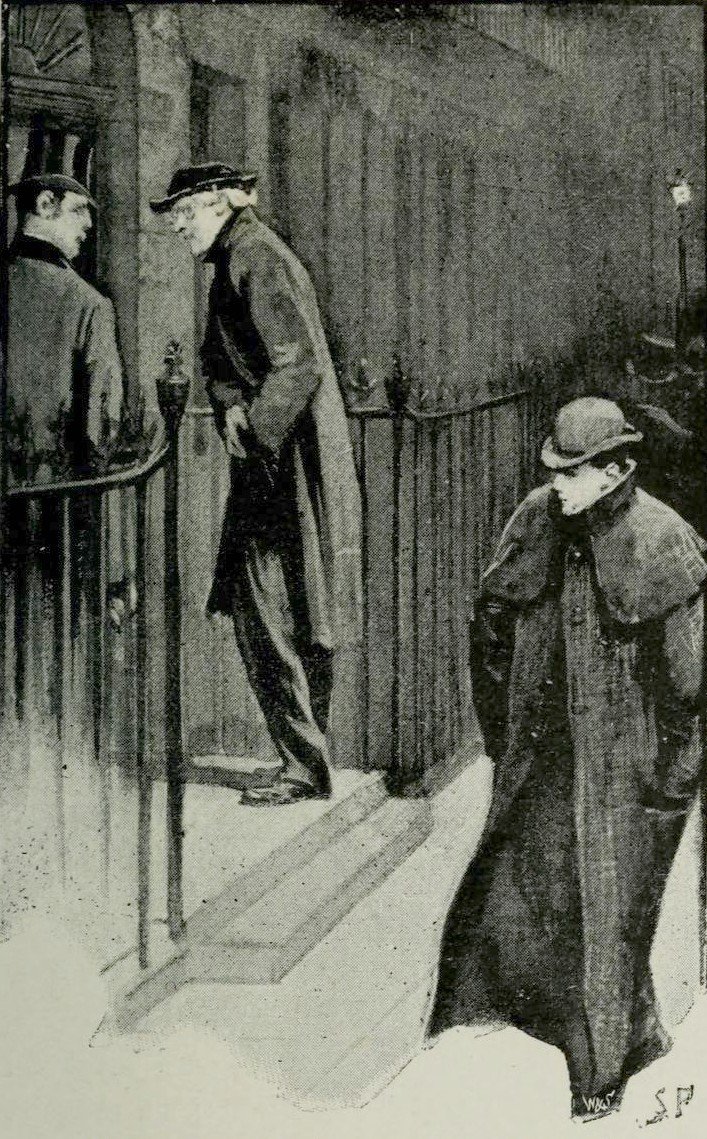
Doyle builds a scene around exactly this. In “A Scandal in Bohemia”, a slim youth in an ulster hurries past Holmes at his door in Baker Street and says, “Good-night, Mister Sherlock Holmes.” Holmes, staring down the dimly lit street, says, “I’ve heard that voice before,” but he cannot place it. The youth is Irene Adler, who later writes that she has been “trained as an actress”. The costume hides her; the voice is the clue Holmes notices (you can read the whole story in Project Gutenberg eBook #1661).
+--------------------------+
| SOURCE WORDS             |
| every word, unchanged    |
+--------------------------+
             |
             v
+--------------------------+
| SPEAKER                  |
| who is talking? one card |
+--------------------------+
             |
             v
+--------------------------+
| SCENE                    |
| deduction, reveal ...    |
+--------------------------+
             |
             v
+--------------------------+
| MARKS                    |
| /  //  ///  bold         |
+--------------------------+
             |
             v
+--------------------------+
| QUALITY GATE             |
| intensity is not volume  |
+--------------------------+
Sound effects need the same discipline. In an experiment with a fictional radio drama, Rodero (2012) found that adding descriptive sound effects, and especially what she calls sound shots, increased listeners’ mental imagery, and that this increase was related to their attention. This finding supports using sound to help a listener picture a scene. It does not test how loud effects should be, so the rule of keeping them below speech remains this guide’s own editorial choice.
All three passages come from stories that are out of copyright: as the Arthur Conan Doyle Encyclopedia explains, the British and European terms expired at the end of 2000, and the last Sherlock Holmes stories entered the American public domain on 1 January 2023.
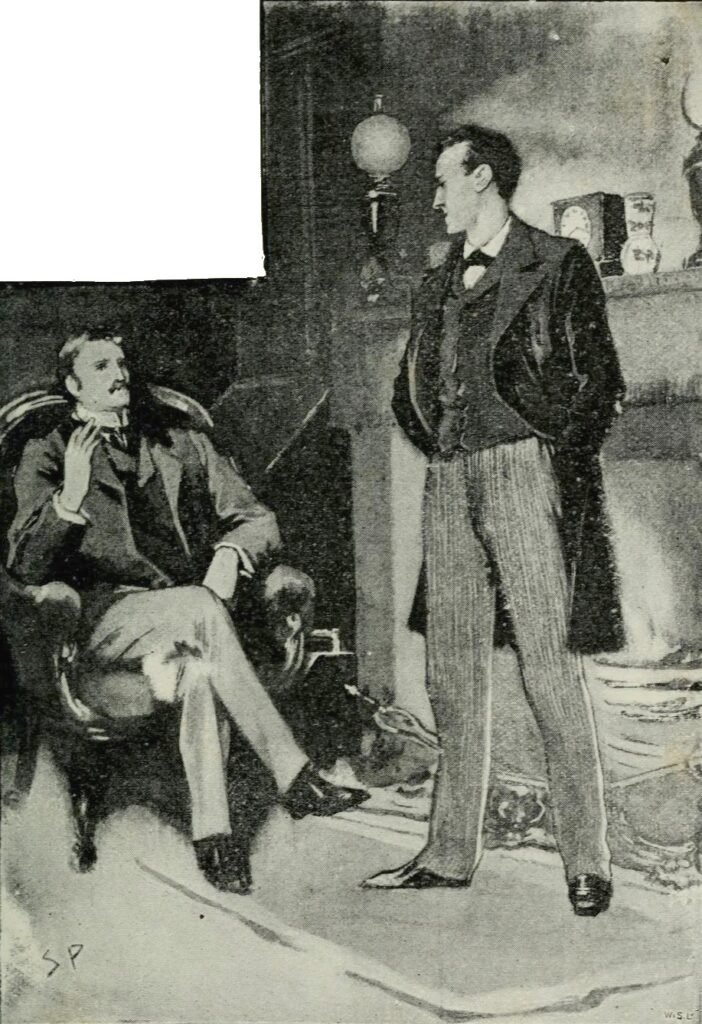

The takeaway: decide who is speaking before you decide how they sound, and then keep that voice steady. Let timing, not volume, carry the reveals, and add sound only when it helps the listener know where they are.
More to read: the Sherlock Holmes reading lab works through the same three passages for meaning, and the Reading Room lists every book studio on this site. For a very different narrating voice, try the Notes from Underground performance guide. If you want more practice with the building blocks, see word stress in English, using intonation to mean more and the Open Teacher Training pronunciation module.
Switch book or mode
Arthur Conan Doyle / 01
Sherlock Holmes
Audiobook Performance Guide
This is a companion guide, and no recording is included. Open the cards to reveal the notes.
Performance rule
Preserve every source word and add performance marks only. Narration and pronunciation coaching stay separate.
Core character cards
WatsonOpen direction
- Placement
- middle / chest
- Rhythm
- steady, humane
- Accent policy
- educated British reference
HolmesOpen direction
- Placement
- forward / dry
- Rhythm
- clipped during deduction
- Accent policy
- precise, restrained
LestradeOpen direction
- Placement
- forward
- Rhythm
- practical, quicker
- Accent policy
- light London colouring only
MoriartyOpen direction
- Placement
- low / still
- Rhythm
- measured
- Accent policy
- no villain caricature
Scene engine
DeductionOpen direction
narrow pitch; speed rises as logic locks.
InterviewOpen direction
conversational timing; silence after evasions.
PursuitOpen direction
shorter groups; breath carries urgency.
Gothic threatOpen direction
slow the room, not every word.
RevealOpen direction
pause before the key fact.
Sound design
Use sound only when the location changes what the listener understands. Baker Street scenes may use a fire, paper, a clock, a door or a carriage in the street; moor scenes may use wind, distant animal calls and footfall; pursuits may use carriage or running textures. Keep effects below speech, and remove sound beds during important deductions.
Accent continuity
Create one card for each recurring speaker, fixing age, placement, pace, pitch span and two accent features. Never change a voice because the scene becomes emotional: emotion changes pressure and rhythm first.
Notation
/Meaning
micro-pause
//Meaning
switch
///Meaning
silence
>Meaning
accelerate
…Meaning
trail
boldMeaning
nucleus
°quiet°Meaning
intensity reduction.
Quality gate
- No invented subtext.
- No accent caricature.
- Intensity is not volume.
- Every long silence has a reason.
- SFX never competes with dialogue.
- Speaker continuity is checked.
RECORDING / YOUR SPACE
Video performance
The recorded performance will appear here.