Seville: the Giralda, Royal Alcázar and Plaza de España (100 Days in Europe, Part 12)
Part 12 of 24 in the 100 Days Europe Travel Journal, our 100 days across Europe by train, plane, ferry and bus.
My notes on Seville open with two words: “colourful and beautiful”. That is high praise from a diary that called Madrid “okay at best”. The rest of the note is a list: the Giralda and the cathedral, with two reminders in brackets, “mosque origins” and “Columbus tomb”; the Royal Alcázar, with a practical tip, “book online”; the Plaza de España; a flamenco show; the Metropol Parasol; and, at the end, “great food and waiters”.
We reached Seville by train from Madrid (Part 11), as the video above shows, and after three days, Days 80 to 82 of the trip, we went on by bus to Faro in Portugal (Part 13). Below, each place in my notes is set beside what the official sources say about it. Together they show why those two brackets in my notes matter: several of the sights on my list stand where older buildings once stood.
The Giralda and the cathedral: from mosque to cathedral
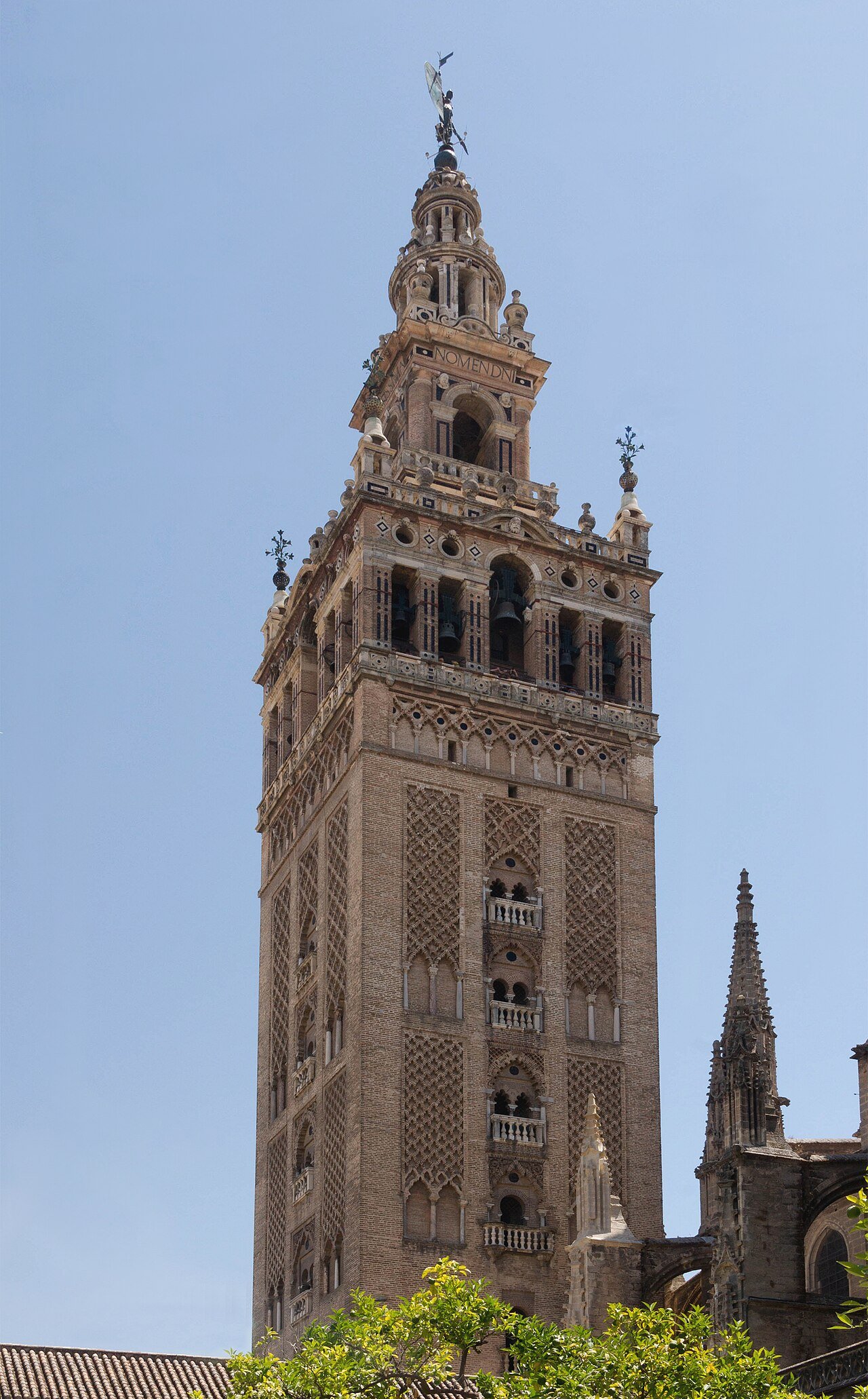
A minaret that became a bell tower
The “mosque origins” in my notes are written into the cathedral’s own history. Its official chronology records that the Almohad caliph Abu Yaqub Yusuf ordered the Great Mosque of Seville in 1172. His son, Abu Yusuf Yaqub, ordered the minaret, the present Giralda; work resumed in brick in 1189, and the minaret, crowned by four golden spheres, was inaugurated in 1198. After the Castilian conquest of 1248 the mosque became the church of Santa María. In 1401 the canons decided to build a new cathedral, and, according to the same chronology, it was inaugurated in 1507.
UNESCO, which listed the cathedral, the Alcázar and the Archivo de Indias as one World Heritage site in 1987, calls the Giralda “the masterpiece of Almohad architecture”. Its top section was designed in the Renaissance by Hernán Ruiz. The mosque’s courtyard survives as well: the Patio de los Naranjos, the Courtyard of the Orange Trees, is now the cathedral’s entrance courtyard. With its five naves, UNESCO adds, the cathedral is the largest Gothic building in Europe.

The tomb of Christopher Columbus
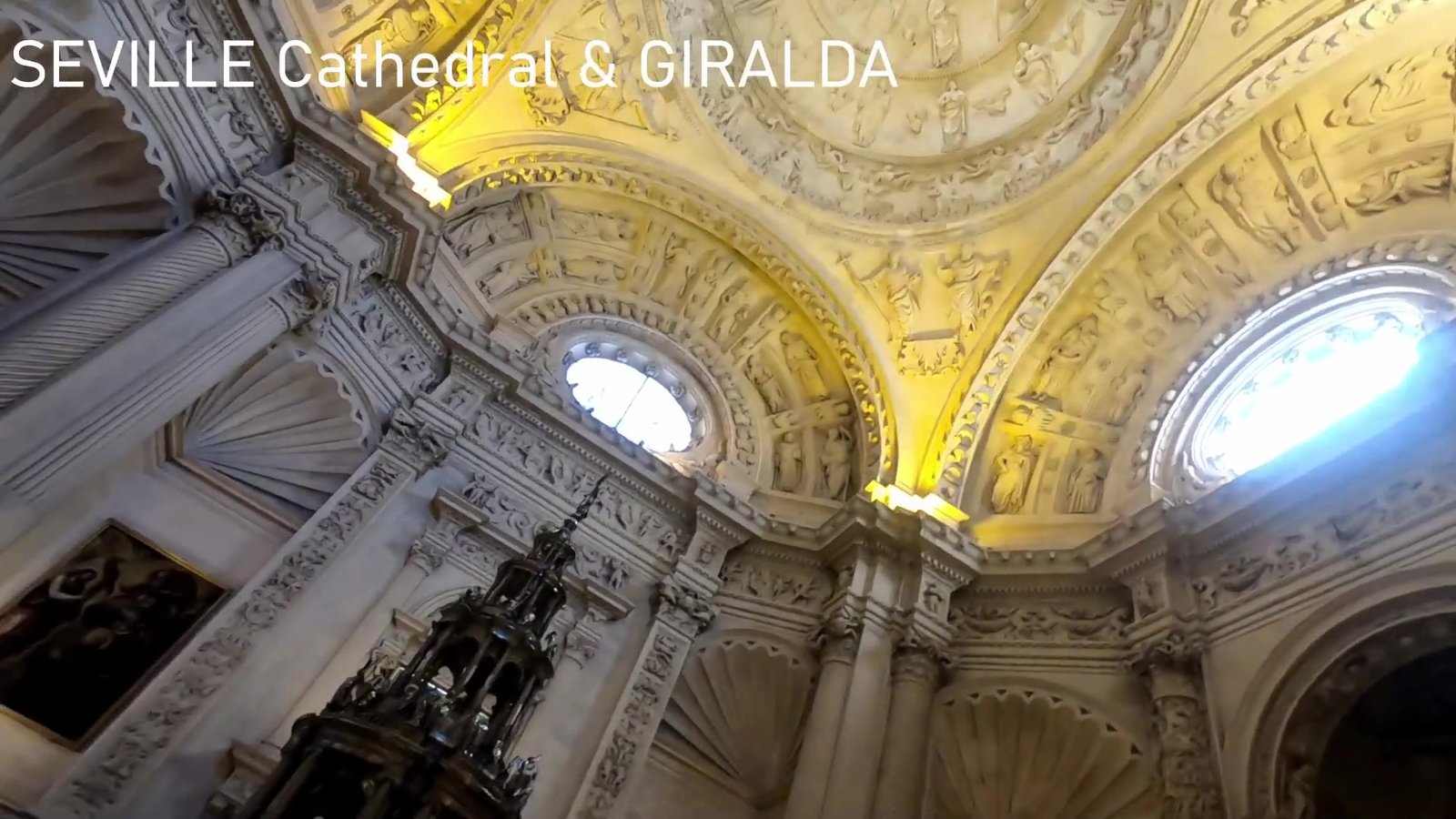
The second bracket, “Columbus tomb”, points to one of the cathedral’s best-known monuments. UNESCO notes that the tomb of Christopher Columbus is in the cathedral, and the cathedral’s chronology records that the Columbus monument was placed there in 1902. The cathedral describes the great tomb as held up by figures of the four historic kingdoms of Spain. Behind the choir is the tomb of his son, Hernando Colón, whose passion for books gave rise to the Biblioteca Colombina, still part of the cathedral’s archives and libraries. My own still from the video shows the ornate ceiling inside the cathedral.


The Royal Alcázar: “book online”
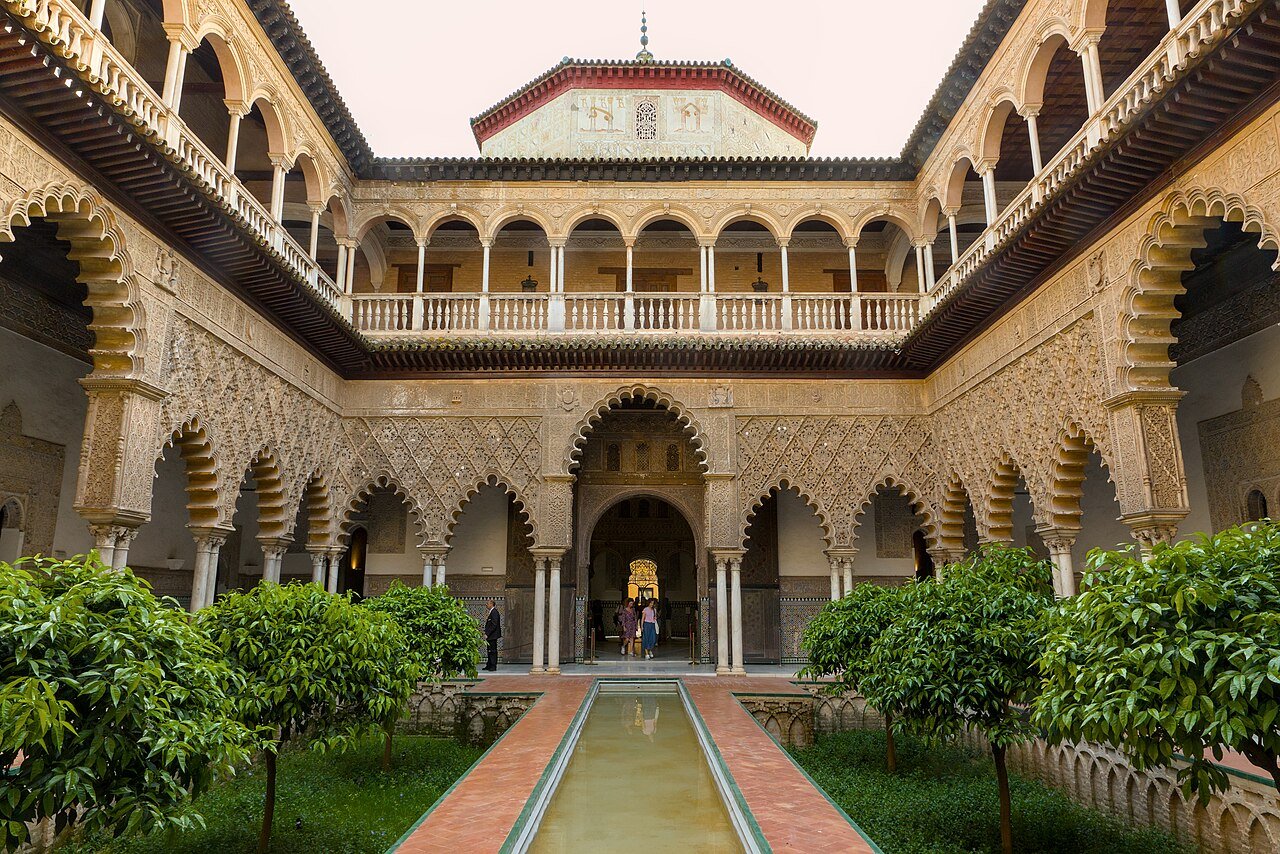
The Royal Alcázar describes itself on its official website as the oldest royal palace still in use in Europe. Its history page (in Spanish) traces its origin to 913, when the Caliph of Córdoba, Abd al-Rahman III, ordered a new seat of government on the southern edge of the city. The Almohads added buildings in the 12th century, and after the Castilian conquest of 1248–49 the Alcázar became the seat of the Crown. New palaces then rose on the older foundations: the Gothic Palace, which reflects the ideas of Alfonso X, and, in the mid-14th century, the Mudéjar Palace of Pedro I, which brought back old Mediterranean ideas in an Arabic form at a time when al-Andalus was already dominated by the Crown of Castile.
UNESCO also links the palace with the Americas. It notes that the Alcázar is still used as the residence of the Spanish royal family in the city, and that its Admirals’ Hall was the headquarters of the House of Trade, where plans were made for voyages such as the circumnavigation of the globe by Magellan and Elcano (1519–1522). As for my tip, the Alcázar’s visitor page still offers tickets online as well as at the box office in the Patio de Banderas, and opening hours change between winter and summer, so they are worth checking before a visit.

The Plaza de España and a flamenco show
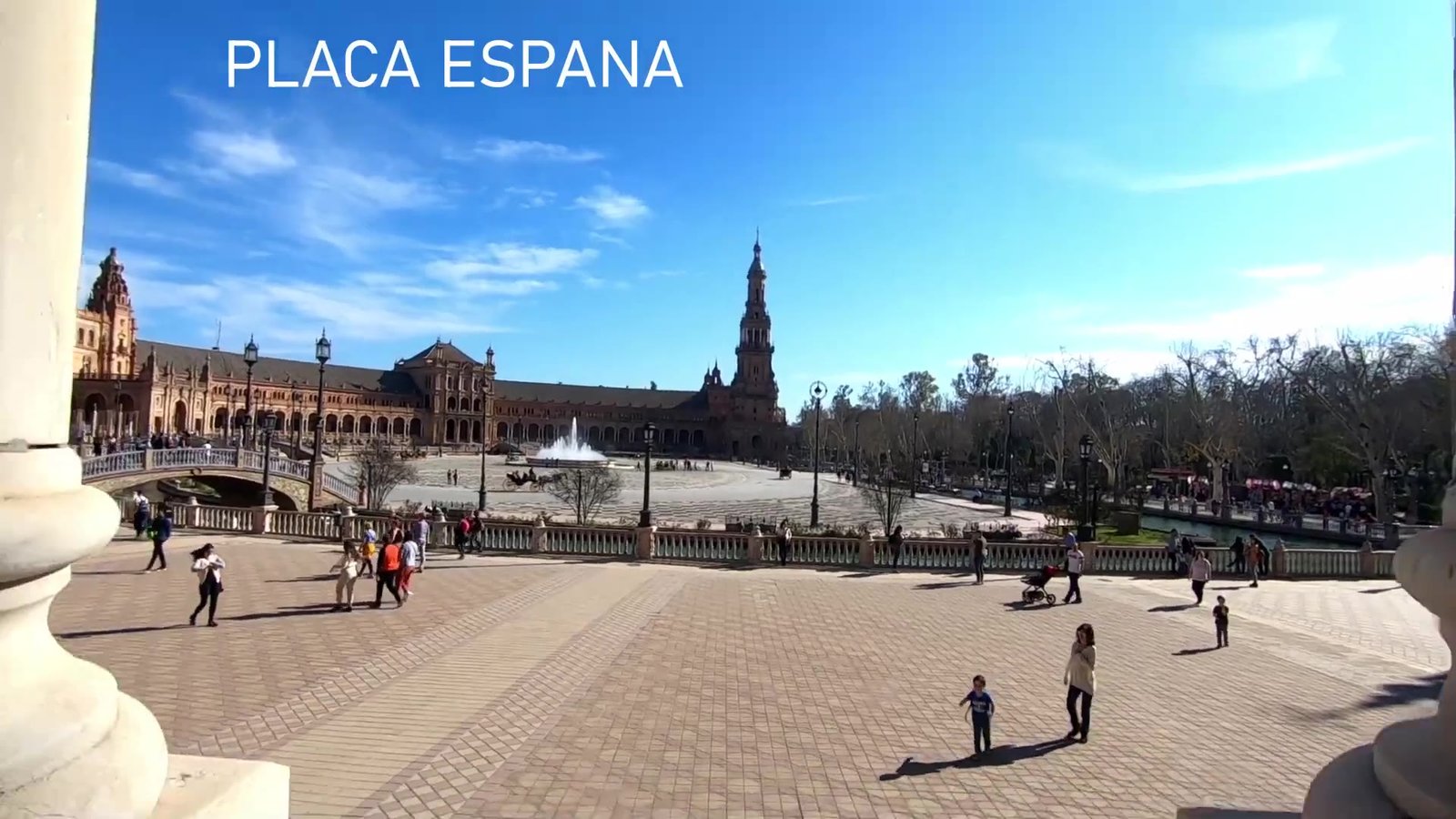
The Plaza de España is younger than it looks. According to Seville’s official tourism website, the architect Aníbal González designed it, and it was built between 1914 and 1928 for the Ibero-American Exposition of 1929. Its semicircular shape symbolises an embrace between Spain and its former territories in America. A canal, which visitors can explore by boat, runs along the building and is crossed by four bridges that stand for the old kingdoms of Castile, León, Aragon and Navarre, and the tiled benches represent the 48 Spanish provinces. My own still from the video shows the plaza on a sunny day.
My notes record a flamenco show but say nothing more about it, so I will not invent the details. What can be said is that flamenco is recognised far beyond Seville: in 2010 UNESCO inscribed it on the Representative List of the Intangible Cultural Heritage of Humanity. UNESCO describes it as a fusion of song (cante), dance (baile) and guitar playing (toque), names Andalusia in southern Spain as its heartland, and notes the essential role of the Gitano (Roma) community in its development.
The Metropol Parasol, and the food
The last sight in my notes is the newest. Seville’s tourism website explains that the Metropol Parasol, known locally as the Setas (“mushrooms”), was designed by the Berlin architect Jürgen Mayer after he won a competition held by the City Council. Its six mushroom-shaped parasols are inspired by the vaults of the cathedral and the ficus trees of the nearby Plaza del Cristo de Burgos, and the structure measures 150 by 70 metres and stands about 26 metres high. Its upper level has a viewpoint and walkways, and its basement houses the Antiquarium, which displays archaeological remains found on the site. The Setas’ own timeline (in Spanish) gives the background: a market opened on the square in 1832 and was demolished in 1973; the competition was held in 2004, work began in 2006, and the Setas opened in 2011.
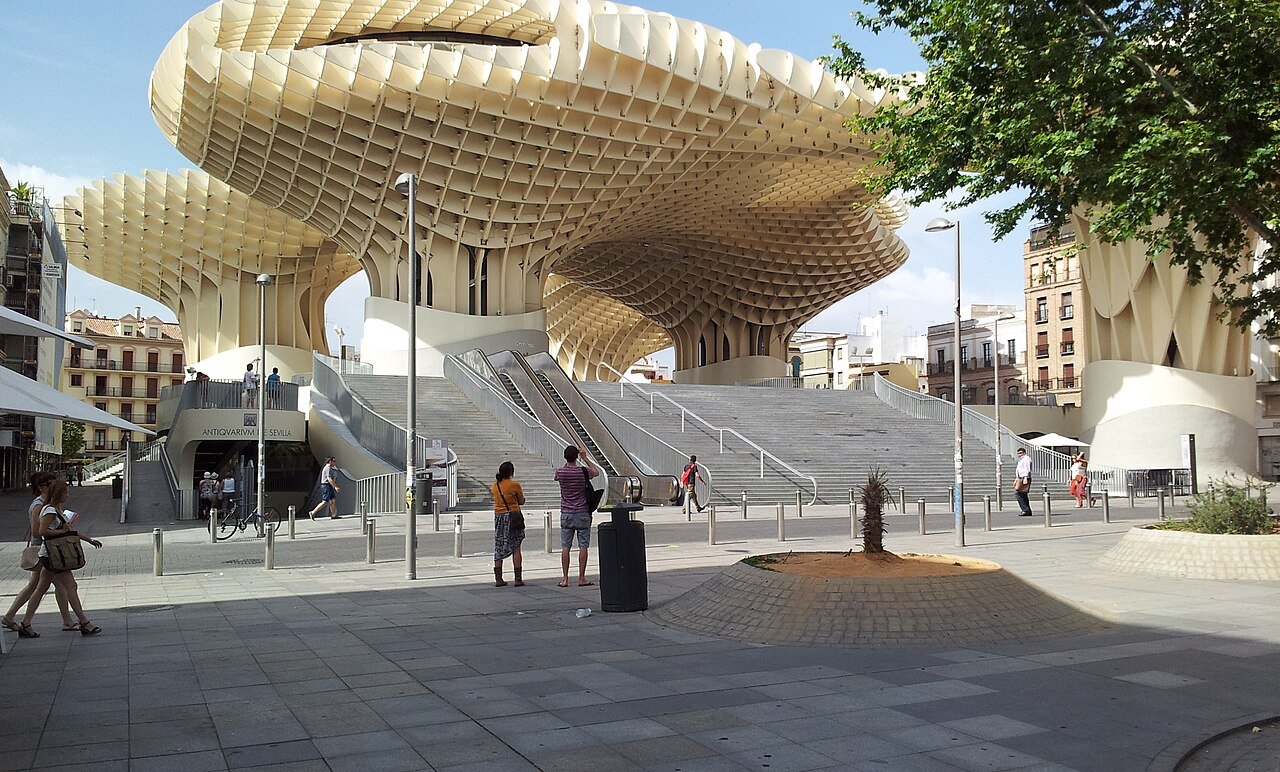

My notes end on the food: “great food and waiters”. I did not write down where we ate or what we ordered, so that line stays as it is.
SEVILLE IN MY NOTES, BY AGE
(dates from the sources cited)

913   seat of government
  |   ordered: the Alcázar's
  |   origin
  |
1172  Great Mosque ordered
  |
1198  its minaret, today's
  |   Giralda, inaugurated
  |
1248  Castilian conquest:
  |   the mosque becomes
  |   a church
  |
1300s Pedro I's Mudéjar
  |   palace in the Alcázar
  |
1401  canons decide on a
  |   new cathedral
  |
1507  cathedral inaugurated
  |
1902  Columbus monument
  |   placed inside
  |
1914  Plaza de España begun
  |   (for the 1929 Exposition)
  |
1987  UNESCO lists cathedral,
  |   Alcázar and Archivo
  |
2010  UNESCO lists flamenco
  |
2011  Metropol Parasol opens
  v
Days 80-82: our three days
The takeaway: Seville wears its history in layers. The Giralda began as the minaret of an Almohad mosque in the 12th century and became the bell tower of a Gothic cathedral that also holds the tomb of Christopher Columbus; the Royal Alcázar grew from a 10th-century seat of government into a royal palace still in use; the Plaza de España was built for the Ibero-American Exposition of 1929; and the Metropol Parasol opened only in 2011. My own notes put it in two words, “colourful and beautiful”, and my practical tip still stands: book the Alcázar online.
100 Days Europe Travel Journal · Part 12 of 24
← Previous: Madrid: the Royal Palace, Plaza Mayor and Retiro Park (100 Days in Europe, Part 11) | Next: Faro and Lisbon: the Bone Chapel, Belém Tower and Pastéis de Belém (100 Days in Europe, Part 13) →
More from the journey: the Europe Travel page (all fifteen parts and the whole trip in one minute) · every Spain post · Part 9: Barcelona · Part 10: Valencia · Part 11: Madrid · Part 13: Faro and Lisbon · Part 1: Geneva