Four Anchors: ADHD Stability Routines That Actually Work
One routine, four anchors
I spent three years writing a morning routine that filled three pages. It had habit stacks, review rituals and optimised time blocks: everything the productivity books say you need. Then I woke up wrong (my bipolar cycling, my ADHD fog), and the entire system collapsed.
So I scrapped it. What I kept was four things. Not four pages. Four anchors.
An anchor is different from a habit. A habit works when you are doing well. An anchor holds when you are not: when you wake with a flat mood, no motivation and no executive function. The test is simple: can I do this on my worst day, half-asleep, with zero willpower?
If yes, it is an anchor. If no, it is a nice idea.
Why this matters for teachers with ADHD
Teaching requires consistent energy. So does managing ADHD. When the two intersect, your nervous system is always slightly fried. You cannot rely on willpower or on enthusiasm for a routine. You need a floor: a set of anchors that hold regardless of your internal state.
The idea of anchoring the day comes from research on mood disorders. Interpersonal and social rhythm therapy (IPSRT), developed by Ellen Frank and colleagues for bipolar disorder, treats regular daily routines as part of treatment. In a two-year randomised trial (Frank et al., 2005) of 175 people with Bipolar I, those who received IPSRT early on went longer without a new mood episode. Those who made their daily rhythms more regular were less likely to relapse. The therapy’s daily diary (Frank, Swartz and Boland, 2007) tracks a handful of fixed points, starting with the time you get out of bed, and therapists sometimes work on that one routine first, aiming for it to vary by no more than about an hour.
Two honest qualifications. First, that trial was done with people with Bipolar I, not ADHD, so for ADHD alone it is a strong hint rather than proof. Second, the strongest time cue for the body clock is not the alarm itself but light. The US National Institute of General Medical Sciences (NIGMS) explains that light and dark have the biggest influence on circadian rhythms, while food intake, physical activity, the social environment and temperature also play a part. A fixed wake time matters because it fixes when that light arrives. The NHS advice for adults with ADHD points in the same direction: get enough sleep, keep a regular bedtime, and aim for regular mealtimes. NIMH notes that ADHD often comes with sleep problems.
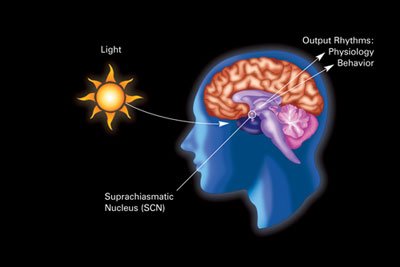

Anchors are how you give your body those signals on the days when your mind cannot. I had one routine, and when it broke, everything broke. Anchors do not break. They are too simple to break.
Step by step: the four anchors
Anchor one: a fixed wake time. The same time, every day, seven days a week. Put the alarm out of reach so that you actually get up. This is non-negotiable because a consistent wake time is one of the clearest signals you can give your body clock, and it decides when the morning light arrives.
Do not negotiate your wake time. Your body needs the signal more than you need the extra sleep.
Anchor two: meds, water and light (five minutes). On waking, before any decision. Take your medication (ADHD or mood) as prescribed. Drink a full glass of water. Get daylight on your eyes: five minutes by a window or outside.
This takes five minutes and anchors the day’s chemistry before your brain has any say in the matter. You cannot negotiate with your brain chemistry first thing in the morning; you pre-empt it. One caution: the timing and dose of any medicine are decisions for your prescriber, not for a routine. The NHS notes that ADHD medicines must be started and monitored by an ADHD specialist.


Anchor three: one real meal (at a roughly fixed time). Not the best meal, not a tracked meal: a real one. A meal is a rhythm cue as well as nutrition. In a laboratory study, Wehrens and colleagues (2017) found that moving meals five hours later did not shift the brain’s master clock, but it did shift the body’s other clocks, including the daily rhythm of blood sugar. Skipping the meal does not just mean hunger. It means you have removed a time cue your body was counting on.
Your students notice when you are stabilised and when you are not. A fixed mealtime is not self-care. It is professional maintenance.
Anchor four: one line written (thirty seconds). “Today I am ______. The one thing is ______.” Two blanks, thirty seconds.
This names your actual state (not the state you wish you had), so that you can plan your day accordingly. It commits you to one thing: the one thing you will do even on a crash day. Everything else is a bonus.
This line also creates a record. On the days when you feel you have accomplished nothing, you can read back and see the pattern: you showed up on the crash days. The streak did not break. The body clock held.
THE FOUR ANCHORS
(my routine; read from the top)

 1. FIXED WAKE TIME
    same time, every day
    -> body clock signal
        |
        v
 2. MEDS + WATER + LIGHT
    five minutes
    -> chemistry before choice
        |
        v
 3. ONE REAL MEAL
    roughly fixed time
    -> rhythm cue + fuel
        |
        v
 4. ONE LINE WRITTEN
    thirty seconds
    -> name state + one thing
Takeaways
The takeaway: anchors work because they are simple enough to hold on bad days. A stable you is a better teacher than an optimised-but-fragile you. Your students do not need your best energy; they need your reliable presence. The research on daily rhythms (strongest in bipolar disorder) and the NHS advice on ADHD point the same way: regular waking, light, meals and sleep are the floor everything else stands on.
The whole system you read about (lesson planning, marking, outreach, digital tools) stands on this floor. Get the floor right, and the rest can be built when you are ready. Neglect it, and nothing holds for long.
Anchors first. Always.
If you are in crisis anywhere in France, including La Réunion, you can call the national suicide prevention line on 3114, free and open 24 hours a day, seven days a week. In an emergency, call 15 or 112.
Related reading: What Bipolar Taught Me That Every Productivity Guru Got Wrong, The Neurodivergent Writer’s Toolkit, Bipolar I at Work, Teaching with ADHD and My Mental Health Journey. For support: Resources, and all the mental health articles.
This is a personal routine, not medical advice. Talk to your doctor before changing medication or treatment.